
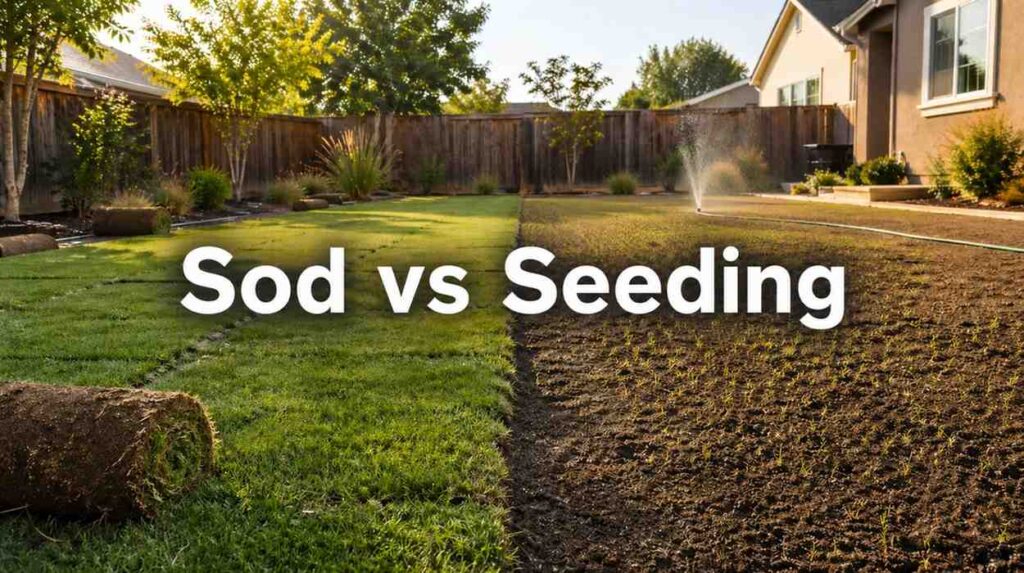
You’ve got a bare yard, and one decision to make: sod or seed. In Yolo County, it’s not just about cost or speed. Heat, soil, and water limits in the Sacramento Valley change how both options perform.
If you’re comparing Sod vs seeding for lawn, the goal is simple, get a lawn that actually works here, without wasting time or water. Many homeowners go for Lawn seeding Yolo County expecting savings, then struggle with patchy growth. Others install sod but run into issues because of poor soil prep or inconsistent watering.
Most of the time, it’s just timing, soil condition, and how well you can manage early care. Here’s how it usually plays out in real conditions.
What Is the Real Difference Between Sod and Seeding?
How sod works
Sod is pre-grown grass, usually Bermudagrass or Tall Fescue, cut into rolls with roots and soil attached. It’s laid directly on prepared ground, almost like fitting pieces of a living carpet. You get an instant green look, but that doesn’t mean it’s fully ready. The roots still need about 2–3 weeks to settle into your soil, especially in Yolo County conditions. Early watering plays a big role here, otherwise sections can dry out or fail to bond properly.
How seeding works
Seeding starts from scratch. Grass seed is spread over soil, then it relies on moisture and temperature to begin grass seed germination time, which usually takes 1–3 weeks. From there, roots develop slowly and fill in over time. It’s more flexible, you can choose mixes suited for a drought tolerant lawn, but it’s also more exposed. Uneven watering, weeds, or even birds can affect how well it comes in.
Core difference (simple explanation)
Sod gives you a ready lawn that still needs to root. Seeding builds the lawn gradually from the ground up.
A simple way to look at it:
- Sod = placing an already grown surface
- Seed = growing it yourself over time
Speed vs control, that’s the real trade-off. When you look at Sod vs seeding for lawn, that’s where it changes, showing up after the first few weeks, not on day one.
Which Option Works Best in Yolo County Climate?
Hot summers and heavy soil conditions make this choice more practical than personal. What looks like a simple sod vs seed decision often depends on how each option handles heat, moisture loss, and early root stability. In this region, success isn’t about what looks better on day one, it’s about what can actually hold up after a few weeks.
Heat impact on sod
Sod copes with heat on the surface, but early on it’s not as strong as it looks. Roots are still shallow. They depend on steady moisture to take hold. Miss a watering or two and edges can dry out before they settle. Get the early care right, though, and it usually beds in without much trouble.
Heat impact on seed
Seed is far more sensitive to temperature. Once the soil heats up, grass seed germination time slows or just stops. Even when it starts, it needs consistent moisture to get through those first days. Any break in that, heat spikes, dry patches, or weed growth, and the lawn comes through uneven.
Why timing matters
Timing makes the biggest difference here. Spring gives both methods a fair chance, while peak summer pushes things toward sod, with extra care. Early fall tends to work best for seeding, as cooler conditions support better root establishment grass without constant watering pressure. That’s usually where things start going wrong, and the timing properly often matters more than the method itself.
Is Sod or Seeding More Cost-Effective?
Cost isn’t just what you pay upfront. It’s what you spend fixing problems later. That’s where most people misjudge this decision.
Upfront cost
In Yolo County, sod is the bigger hit straight away. A full install, including labour, usually lands between $1–$2 per sq ft. For an average yard, that adds up quickly. With Lawn seeding Yolo County, the starting cost is much lower. Seed, basic tools, and prep stay relatively cheap, but it comes with more effort and uncertainty.
Long-term cost
Sod tends to settle faster, which means fewer early repairs if it’s installed properly. But it does rely on consistent watering early on. Seed is cheaper to start, but not always cheaper to finish. Uneven growth, reseeding, or weed control can add up in the first year. Over time, though, it often develops a stronger, more adaptable root base.
ROI comparison
| Factor | Sod | Seed |
| Initial cost | High | Low |
| Risk (early stage) | Lower | Higher |
| Maintenance (first year) | Moderate | Higher |
| Long-term value | Stable | Cost-efficient |
If you’re short on time, sod usually makes sense, and managing budget and can wait, seed often wins long term. It’s not complicated, but it does get overlooked a lot.
Which Option Uses Less Water in Yolo County Conditions?
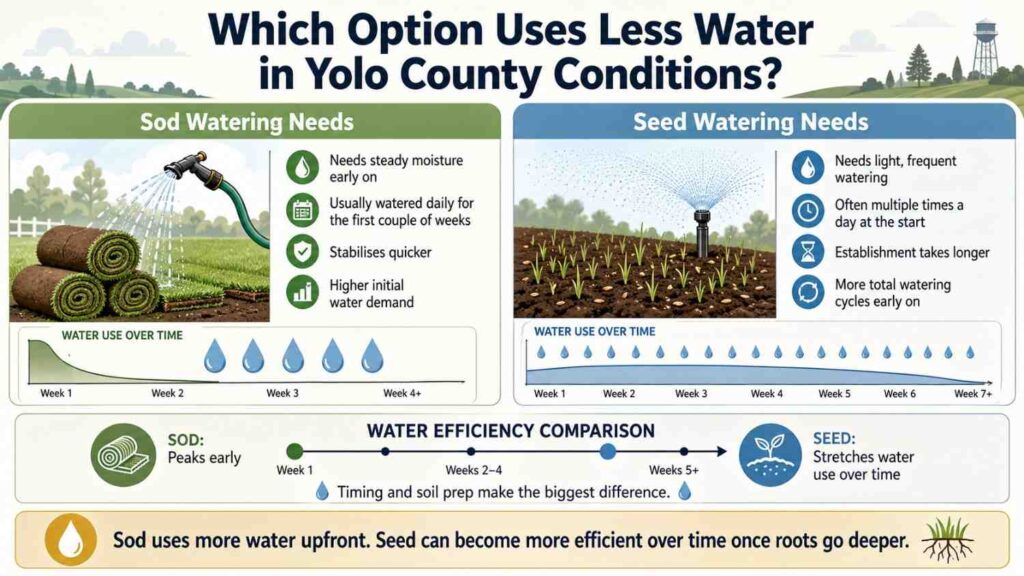
Water use is what matters more, as it shows up, especially with local limits and rising costs. What looks efficient on paper doesn’t always hold up once you factor in establishment time and consistency. Local estimates and guidance from University of California Agriculture and Natural Resources show timing and soil prep make the biggest difference in success rates.
Sod watering needs
New sod needs steady moisture early on. For the first couple of weeks, it’s usually watered daily to help roots settle. After that, it shifts to a normal schedule. The upside is it stabilises quicker, but the initial demand is higher, especially during warm spells.
Seed watering needs
Seeding works differently. It needs light, frequent watering at the start, often multiple times a day, to keep the surface from drying out. That phase lasts longer, which means more total watering cycles before it fully establishes.
Water efficiency comparison
Short term, sod uses more water upfront. Over time, seed can become more efficient once roots go deeper and improve soil moisture retention. In simple terms: sod peaks early, seed stretches it out. That’s usually where Sod vs seeding for lawn becomes less about preference and more about how much water you’re willing to manage early on. Most people don’t realise this until the water bill shows up.
How Long Does Sod vs Seed Take to Grow?
Time is usually the biggest factor behind this decision. Some homeowners want a usable lawn as quickly as possible, while others are fine waiting if the end result is stronger. The timeline between the two methods isn’t even close, especially in local conditions.
Sod timeline
Sod gives you an instant green surface from day one, but that’s just the appearance. Underneath, roots still need time to connect with the soil.
- Week 2–3: roots begin to settle
- Week 4: light use is usually fine
- Week 6–8: stronger, more stable lawn
With proper care, it’s easily the fastest way to grow lawn Yolo County, especially if you need results quickly. Pick the wrong method for the season, and you’ll likely end up reseeding or replacing sections within weeks.
Seed timeline
Seeding takes longer and depends heavily on conditions. Early stages are slow, and consistency matters more than anything.
- Week 1–3: grass seed germination time
- Week 4–6: visible coverage starts filling in
- Week 8–12: lawn becomes usable
It builds gradually, but once established, it can form a more even surface. If the base isn’t right, even the best lawn choice won’t hold up for long.
Real expectations
Sod gives you speed, but it still needs time to fully establish. Seed takes patience, but the payoff is in how it develops over time. If you need a quick result, sod fits better, and not in a rush, seed can work just as well with the right setup.
Which Lawn Option Lasts Longer?
Durability isn’t just about how it looks in the first month. It’s about how the lawn handles heat, wear, and recovery over time, especially in busy gardens.
Durability comparison
Early on, sod has the edge. It arrives as a complete layer, so it copes better with heat and dry spells in the first few weeks. Seed takes longer to catch up. But once it’s fully established, the difference fades. With proper care, or light overseeding, it can match sod in overall lawn durability comparison terms. You notice the difference more after a few months, not straight away.
Traffic tolerance
That’s where it shows the gap is clear. Sod can handle light use quite early, which makes it more practical for families or pet areas. Seeded lawns need time. Walking on them too soon can thin out growth or create uneven patches, so they’re best left alone for several weeks.
Longevity
Long term, both options can last years if maintained properly. Where it really shows is coming down to usage. For high-traffic areas, sod tends to hold up better early on, and for low-use spaces, seed works well and gives more flexibility in how the lawn develops.
What Is the Best Time to Install Sod or Seed?
Timing makes more difference than most people expect. Get the window right and both options settle in with fewer issues. Get it wrong, especially in peak heat, and even a good setup can struggle to establish properly.
Best seasons
Early spring and early fall give the best conditions. Cooler air, steadier moisture, and lower soil stress all help roots take hold faster. For seeding, fall tends to work better as the soil is still warm but the surface stays cooler. Sod handles both seasons well, provided the ground is prepared properly.
Summer risks
This is where problems start. High temperatures increase water loss and slow down root development. If you’re thinking about the Best time to lay sod Yolo County, mid-summer isn’t ideal. It can still work, but it needs strict watering and close attention. Seeding during this period is far less reliable.
Ideal months
- Sod → late winter to early spring, and again in early autumn
- Seed → early fall or mid-spring
Avoid the peak summer stretch where heat and dry soil make establishment harder than it needs to be. Most lawn issues start below the surface, not with sod or seed. Poor prep means weak roots and uneven growth. Get the ground right first.
Step-by-step guide
Check soil condition first. A slightly neutral range works best,kits from the University of California Agriculture and Natural Resources can help.
- Clear out weeds, old grass, and debris. A sod cutter speeds this up on larger areas.
- Loosen the top layer (around 4–6 inches) and mix in compost to improve soil moisture retention.
- Level the surface so water doesn’t sit in low spots.
- Lightly firm the soil with a lawn roller to improve contact before laying sod or spreading seed.
- Water the area once before installation to settle the base.
- Good soil preparation for lawn work avoids most early failures.
Which Grass Types Work Best for Each Method?
The method matters, but grass type decides how well it actually holds up. Pick the wrong one, and even good installation won’t save it, especially in this climate.
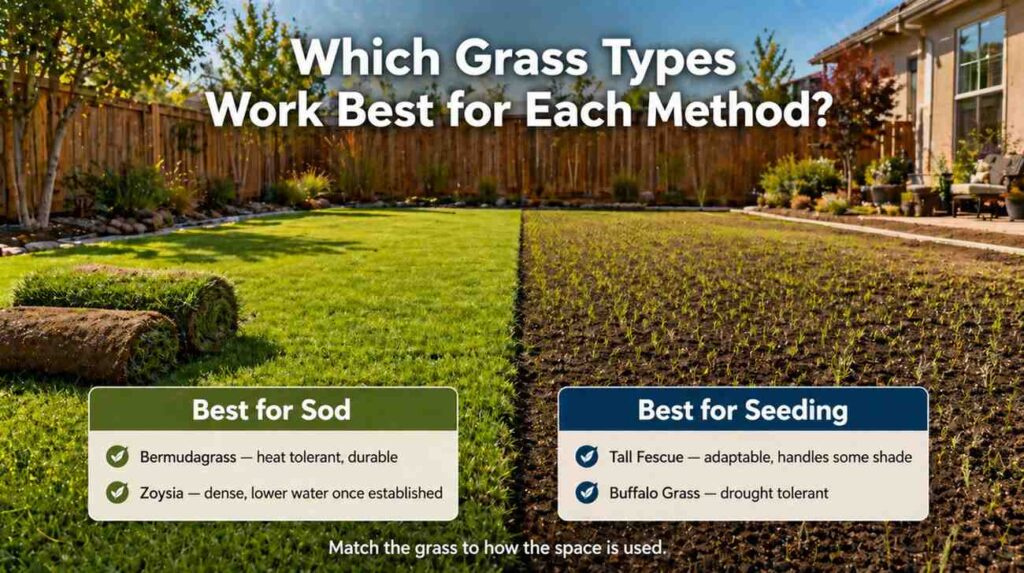
Best for sod
Sod usually comes in warm-season varieties that deal better with heat and dry spells.
- Bermudagrass — handles heat well, recovers quickly from wear
- Zoysia — thicker growth, needs less water once established
These work better when you want quick coverage that can handle regular use.
Best for seeding
Seeding gives you more flexibility, especially if you’re planning for long-term results rather than speed.
- Tall Fescue — reliable, handles some shade, adapts well
- Buffalo Grass — strong choice if you’re aiming for a drought tolerant lawn
This is where Best grass for Yolo County climate becomes important, mixes tend to perform better than single types.
Selection guide
There’s no one-size answer here.
- Full sun + heavy use → Bermudagrass (sod)
- Mixed conditions → Tall Fescue (seed)
- Low water focus → Buffalo Grass
Match the grass to how the space is used, not just how it looks. The grass type you pick often matters more than the method itself.
Sod vs Seeding: Which One Should You Choose?
At this point, the decision should feel clearer. It’s less about what’s “better” and more about what fits your situation. It looks cheaper on paper. It doesn’t always stay that way.
Decision checklist
Choose sod if:
- You need results quickly
- You’re working within a tight timeline
- You’re okay with a higher upfront spend (Sod installation cost Yolo County)
Choose seed if:
- You’re planning ahead and not rushing
- You want more control over grass type
- You’re thinking long-term savings and Sod vs seed cost comparison matters to you
Final recommendation
If you’re still weighing Sod or seeding for new lawn, here’s the simple take:
- Sod works when time matters more than cost
- Seed works when planning and efficiency matter more than speed
For most homeowners, seed ends up being the smarter long-term choice, especially if it’s done at the right time and with proper setup. But if you need a usable lawn quickly or the ground isn’t in great shape, sod can save you time and rework.
Sod vs seeding Yolo County: Why Our Approach Works Better
Most lawns don’t fail because of sod or seed, they fail because the setup’s off. We start with soil, not guesswork. Grass choice matches use, Tall Fescue for mixed areas, Bermudagrass for full sun. Watering is planned early with a simple sprinkler system or soil moisture sensor. Same method, different result, because it’s done properly.
Strategic Conclusion
There’s no universal winner here. In Yolo County, it comes down to climate, soil condition, and timing, get those right and either option can work.
- Sod gives you speed and a quicker finish
- Seed gives you flexibility, lower cost, and better long-term control
If you’re still looking at Sod vs seeding for lawn, don’t overthink it. Most lawns fail because the ground isn’t ready or the timing’s off, not because the method was wrong. Take a step back. Look at your soil, your schedule, and how much effort you’re actually going to put in. That usually makes the decision easier. If you’re still unsure, getting local soil checked can save you a lot of trial and error.
Most homeowners get better results with a quick consultation before installing anything. A quick local check before starting usually saves more than fixing mistakes later.