
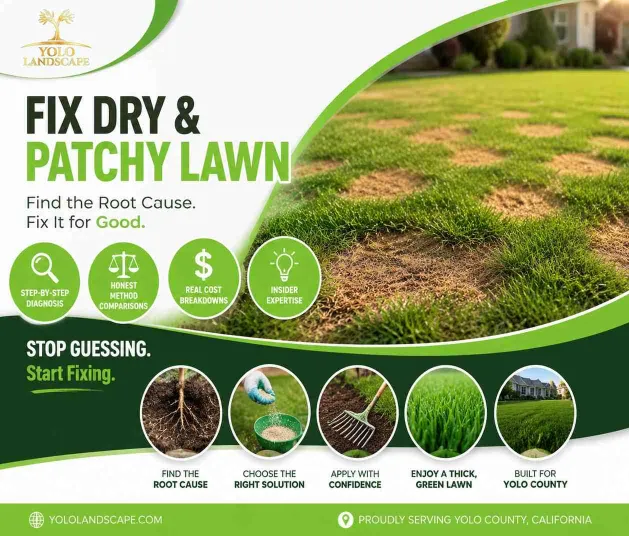
Three months ago, a homeowner in Davis, California, called us in frustration. She had watered her lawn every single day for six weeks. Still, her yard looked like someone had taken a cookie-cutter to it, punching out random circles of brown, dead grass. She had spent over $200 on fertilizer and seed. Nothing worked.
Sound familiar?
Here is the hard truth most lawn care guides will not tell you: watering more is almost never the real fix. Neither is throwing seed at bare ground and hoping for the best. Patchy lawn problems almost always have a root cause hiding beneath the surface. Until you find it, you are just treating symptoms.
So what actually causes a dry and patchy lawn, and how do you fix it for good? That is exactly what this guide covers. You will get a step-by-step diagnosis process, honest comparisons of every repair method, real cost breakdowns, and the kind of insider knowledge that comes from years of lawn restoration work in Yolo County, California.
Let’s fix this properly.
Executive Summary
Here is what you will walk away knowing:
- The seven most common causes of bare patches in lawn areas
- How to diagnose your specific problem before spending a dollar on repairs
- Whether grass seed or sod is right for your situation
- A realistic recovery timeline for every repair method
- How to stop patches from coming back next season
Most lawns recover fully in 4 to 8 weeks when the underlying cause is treated correctly. Average DIY repair costs run $30 to $150.Professional lawn restoration services in Yolo County typically range from $100 to $400, depending on lawn size and severity.
One thing I want to flag early: California’s Central Valley climate adds a layer of complexity here. Summer temperatures regularly hit 100°F, and drought conditions push even healthy turf to its limits. If you are in Davis, Sacramento, or Winters, your timing and grass-type choices matter more than almost anywhere else.
What Actually Causes a Dry and Patchy Lawn?
What causes dry patches on a lawn? The short answer: soil problems, pest damage, disease, poor watering habits, and sometimes simply the wrong grass type for your conditions. Here are the most common culprits.
Soil Compaction: The Silent Killer Under Your Feet
Soil compaction is the number one overlooked cause of a patchy lawn. When clay-heavy soil gets compressed by foot traffic, vehicles, or even heavy rain, it squeezes out the air pockets that grass roots need to breathe. Water sits on the surface instead of soaking in. Roots stay shallow. Grass thins out and eventually dies in patches.
Here is a simple test. Push a screwdriver into the soil. If you cannot push it 4 to 6 inches with reasonable pressure, your soil is compacted.
The fix is core aeration, which removes small plugs of soil to open up the root zone. Tools like the Yard Butler Core Aerator ($35 to $55) work well for smaller areas. For larger lawns, renting a power aerator runs about $60 to $90 per day.
Thatch Buildup Blocking Water from Reaching Roots
Thatch is the layer of dead grass stems and roots that accumulates between the green blades above and the soil below. A thin layer (under half an inch) is actually healthy. But once it exceeds half an inch, thatch acts like a sponge that absorbs water before it ever reaches the soil. Thatch buildup leads directly to dry grass recovery problems, even when you are watering properly.
Run your fingers down to the soil. If you feel a spongy, matted layer more than half an inch thick, it is time to dethatch.
The Greenworks 14-inch Dethatcher ($120 to $180) handles most residential lawns well. For smaller areas, a manual power rake works fine.
Drought Stress vs. True Dead Grass: How to Tell the Difference
This one trips people up constantly, and I understand why. Both look brown. But dormant grass and dead grass need completely different treatments.
Dormant grass is just sleeping. The turfgrass crown (the white tissue at the base of each blade, right at soil level) is still alive. Tug a handful of brown grass. If it resists and stays rooted, it is likely dormant.
Dead grass pulls out easily with no resistance. The crown looks brown or gray, not white.
Here in Yolo County, Tall Fescue goes semi-dormant during peak summer heat. Many homeowners mistake this for dead grass revival situations and over-treat. Check the crown first before you start any lawn patch repair work.
Dog Urine, Grubs, Fungal Disease, and Other Hidden Causes
Some patches have nothing to do with soil or watering.
Dog urine creates distinctive circular yellow rings with bright green edges. The high nitrogen and salt content burns grass in the center while fertilizing the perimeter.
Grubs (white grub larvae from Japanese beetles and June beetles) eat grass roots from below. The turf feels spongy underfoot and peels back like a carpet when pulled. If you see birds pecking aggressively at one section of the lawn, grubs are likely the cause.
Brown patch fungus creates circular rings from 3 to 25 feet wide, often with a darker “smoke ring” border. It thrives in humid conditions, especially after warm nights above 70°F.
| Cause | Visual Sign | Fix |
|---|---|---|
| Soil compaction | Thin, slow-growing grass | Core aeration |
| Thatch | Spongy feel, poor water absorption | Dethatching |
| Dog urine | Yellow circle, green edge | Flush and reseed |
| Grubs | Spongy turf peels back | Grub treatment + reseed |
| Brown patch fungus | Circular rings | Fungicide + aerate |
| Drought stress | Uniform browning | Deep watering adjustment |
How Do I Diagnose My Specific Patchy Lawn Problem?
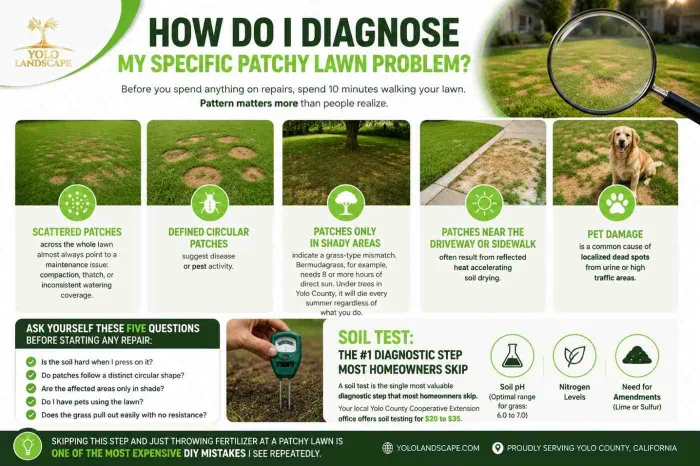
Before you spend anything on repairs, spend 10 minutes walking your lawn. Pattern matters more than people realize.
Scattered patches across the whole lawn almost always point to a maintenance issue: compaction, thatch, or inconsistent watering coverage.
Defined circular patches suggest disease or pest activity.
Patches only in shady areas indicate a grass-type mismatch. Bermudagrass, for example, needs 8 or more hours of direct sun. Under trees in Yolo County, it will die every summer regardless of what you do.
Patches near the driveway or sidewalk often result from reflected heat accelerating soil drying.
Ask yourself these five questions before starting any repair:
- Is the soil hard when I press on it?
- Do patches follow a distinct circular shape?
- Are the affected areas only in shade?
- Do I have pets using the lawn?
- Does the grass pull out easily with no resistance?
A soil test is the single most valuable diagnostic step that most homeowners skip. Your local Yolo County Cooperative Extension office offers soil testing for $20 to $35. You will learn your soil pH (optimal grass range is 6.0 to 7.0), nitrogen levels, and whether you need amendments like lime or sulfur. Skipping this step and just throwing fertilizer at a patchy lawn is one of the most expensive DIY mistakes I see repeatedly.
What Is the Best Way to Fix Dry Patches on a Lawn?
The best method depends entirely on what caused the patches. That said, three repairs address the majority of cases we see across Yolo County.
Method 1: Adjust Your Watering Schedule First
Most homeowners water too often and too shallowly. Daily 10-minute watering sessions create shallow root systems that dry out fast and cannot tolerate heat stress.
Switch to deep, infrequent watering. Water 2 to 3 times per week, delivering half an inch of water per session. This plant’s roots grow deep where the soil stays cooler and more moisture is available.
Also, check your sprinkler head alignment. A single misaligned head creates a dead zone that looks like a disease problem but is simply a dry patch lawn-repair issue.
For areas with hydrophobic soil (water beads on the surface instead of soaking in), a wetting agent like Scotts Turf Builder Wetting Agent ($15 to $20) makes a significant difference.
Method 2: Core Aeration for Compacted Soil
Core aeration is the best starting point if your soil is compacted. It is also the most powerful preparation step before overseeding.
Best timing for Yolo County: early fall (September to October) for Tall Fescue and cool-season grasses or late spring (May to June) for warm-season varieties like Bermudagrass and Zoysia Grass.
After aerating, topdress with a light quarter-inch layer of compost. This dramatically improves seed-to-soil contact and speeds up lawn recovery after drought.
Our “lawn maintenance” services page at Yolo Landscape explains the full “lawn aeration and maintenance” process we use for clients across Davis and Sacramento.
Method 3: Dethatching Before You Reseed
If your thatch layer exceeds half an inch, dethatching before any overseeding is non-negotiable. Seed dropped onto thick thatch will germinate poorly and dry out before roots establish.
One important warning: never dethatch during heat stress periods (June through August in the Central Valley). Only dethatch when the grass is actively growing and temperatures are moderate.
Should I Use Grass Seed or Sod to Fix Bare Patches?
This is the question I get asked most often, and the honest answer is: it depends on your timeline, budget, and the size of the damage.
When Overseeding Makes Sense
Overseeding a patchy lawn works best for patches under about 6 square feet, homeowners on a tighter budget, and situations where you have 6 to 8 weeks before needing the lawn to look its best.
Apply seed at 25 to 35 grams per square meter for bare patch lawn repair. Fall overseeding (September through October) produces the best results for cool-season grasses in Yolo County. Soil temperatures in the 50°F to 65°F range are ideal for grass seed germination.
Dr. Frank Rossi from Cornell University’s Turf Management Department notes that new seedlings must never fully dry out, even once. A single complete drying event kills the seedling. Plan to water lightly 2 to 4 times daily for the first two weeks.
When Sod Makes More Sense
Sod installation makes sense when patches exceed 6 square feet, you need fast results (hosting an event, selling your home), or the damaged area receives heavy foot traffic.
At Yolo Landscape, we have completed “sod installation” projects ranging from small patch repairs to complete front yard rebuilds across Yolo County. Fresh sod establishes visible results within 1 to 2 weeks, compared to 4 to 6 weeks for seed.
Buy 10 to 15 percent more sod than you measure. You will need the extra for trimming around edges.
| Factor | Grass Seed | Sod |
|---|---|---|
| Cost | $20 to $60 | $200 to $800+ |
| Time to results | 4 to 6 weeks | 1 to 2 weeks |
| Effort required | High | Medium |
| Best for | Budget repairs, small areas | Fast results, large patches |
| Risk level | Higher (weather dependent) | Lower |
What Is the Correct Way to Overseed a Patchy Lawn?
Overseeding is straightforward when you do it right. Here is the exact process we follow.
Step-by-step overseeding guide:
- Mow existing grass to 2 to 3 inches
- Rake out dead material and debris thoroughly
- Loosen soil 3 to 4 inches deep with a hand cultivator
- Apply starter fertilizer (10-10-10 formulation) or compost
- Spread seed evenly with a lawn spreader at the correct rate for your grass type
- Lightly rake seed into the top quarter inch of soil
- Cover lightly with straw (not hay, which contains weed seeds)
- Water lightly 2 to 4 times daily for the first two weeks
- Reduce watering frequency by week six as roots establish
- Wait until seedlings reach 3 to 4 inches before the first mow
Common overseeding mistakes that kill results:
- Seeding too densely (weak, spindly seedlings compete and fail)
- Letting seedlings dry out even once during the germination period
- Mowing too soon before roots have anchored
- Using high-nitrogen fertilizer on new seedlings (it burns them)
How Long Does It Take to Fix a Patchy Lawn?
Here are realistic timelines. Notice that instant lawn fixes almost never exist.
| Method | Visible Results | Full Recovery |
|---|---|---|
| Watering adjustment | 1 to 2 weeks | 3 to 4 weeks |
| Overseeding | 2 to 4 weeks | 6 to 8 weeks |
| Sod installation | 1 to 2 weeks | 4 to 6 weeks |
| Aeration + overseed | 3 to 4 weeks | 6 to 10 weeks |
| Fungicide treatment | 2 to 3 weeks | 4 to 6 weeks |
Lawn recovery after drought in our area can take slightly longer in summer because of ongoing heat stress. If you repair in September or October, you will almost always see faster, more reliable results than summer attempts.
Are There Different Fixes for Shady vs. Sunny Patchy Areas?
Absolutely, and getting this wrong wastes money every single time.
Patches in Full Shade (Under Trees)
Bermudagrass is one of the most common grasses in California, but it requires 8 or more hours of direct sunlight to thrive. Under mature trees, it will thin out and die no matter how well you maintain it.
For shade-tolerant grass varieties, Tall Fescue is your best option in Yolo County. It tolerates 4 to 5 hours of filtered light. In deep shade situations (under dense canopy), sometimes the honest answer is ground cover plants or decorative rock rather than grass.
Our landscaping team covers both options. You can browse our decorative rock and landscaping design work on the Yolo Landscape services page to see alternatives that actually hold up under trees in our climate.
Patches Near Driveways and Hardscape
Concrete and asphalt reflect heat aggressively, especially in summer. Grass near a driveway in Davis, California, can experience soil temperatures 15°F to 20°F higher than the rest of the lawn.
For these areas, drought-tolerant grass types like Zoysia Grass or Bermudagrass handle reflected heat better than Tall Fescue. Adjust your watering schedule to run these zones slightly longer than the rest of the lawn.
What Lawn Care Mistakes Are Making My Patchy Lawn Worse?
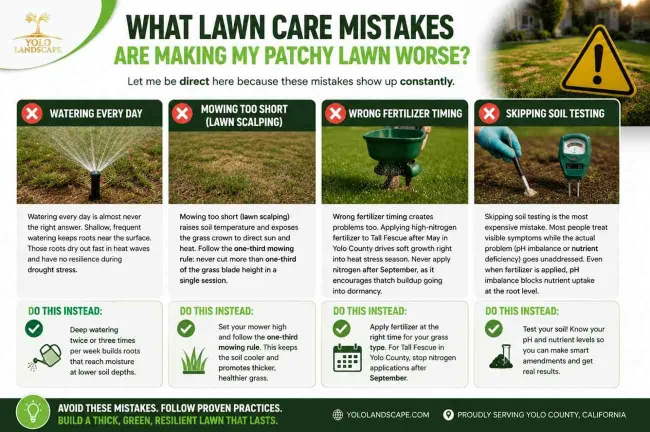
Let me be direct here because these mistakes show up constantly.
Watering every day is almost never the right answer. Shallow, frequent watering keeps roots near the surface. Those roots dry out fast in heat waves and have no resilience during drought stress. Deep watering twice or three times per week builds roots that reach moisture at lower soil depths.
Mowing too short (lawn scalping) raises soil temperature and exposes the grass crown to direct sun and heat. Follow the one-third mowing rule: never cut more than one-third of the grass blade height in a single session.
Wrong fertilizer timing creates problems too. Applying high-nitrogen fertilizer to Tall Fescue after May in Yolo County drives soft growth right into heat stress season. Never apply nitrogen after September, as it encourages thatch buildup going into dormancy.
Skipping soil testing is the most expensive mistake. Most people treat visible symptoms while the actual problem (pH imbalance or nutrient deficiency) goes unaddressed. Even when fertilizer is applied, pH imbalance blocks nutrient uptake at the root level.
When Is the Best Time to Repair a Patchy Lawn in Yolo County?
Timing is everything. A repair done at the wrong time fails even with perfect technique.
For cool-season grasses like Tall Fescue, Kentucky Bluegrass, and Perennial Ryegrass, the best repair window is early fall (September through October). This is why soil is still warm enough for grass seed germination, but air temperatures are cooling. Seedlings establish before winter without summer heat stress working against them.
Spring (late March through April) is a secondary window for cool-season repairs.
| Season | Cool-Season Grass | Warm-Season Grass |
|---|---|---|
| Spring | Good (secondary window) | Best window |
| Summer | Avoid repairs | Good window |
| Fall | Best window | Too late |
| Winter | Dormant, no repairs | Dormant |
For warm-season grasses (Bermudagrass, Zoysia), late spring through summer is ideal. Avoid attempting repairs in fall when these grasses are heading into dormancy.
Should I Fix My Patchy Lawn Myself or Hire a Professional?
This is a genuinely honest question that deserves a genuinely honest answer.
You can handle it yourself when
- Patches are smaller than 6 square feet total
- The problem is isolated (not recurring every season)
- You have time to water seedlings consistently for 6 to 8 weeks
- The cause is something simple like compaction or thatch
It makes sense to call a professional when:
- Patches return every season despite your repairs
- Large-scale pest infestation or drainage problems are involved
- You suspect grading or irrigation issues creating dead zones
- The total damaged area is large enough that DIY becomes impractical
A real case from our work in Yolo County:
Last fall, a homeowner in Winters reached out about persistent dead zones that returned every August for three straight years. Every summer, he reseeded. Every summer, the patches came back. When we assessed the situation, we found two problems stacking on each other: severe soil compaction from clay soil, combined with a sprinkler head that had been deflected 15 degrees, leaving a specific zone dry.
We completed core aeration, corrected the sprinkler alignment, and overseeded in September. By November, the lawn had full coverage. That was the first fall without dead zones in four years.
This kind of diagnosis is what separates a lasting fix from another season of wasted effort. Our team provides “professional lawn repair and maintenance” across Davis, Sacramento, Winters, and surrounding Yolo County communities.
Best Tools and Products for Fixing a Patchy Lawn
| Product | Best For | Avg. Cost |
|---|---|---|
| Scotts EZ Seed Patch and Repair | Small bare spots | $20 to $40 |
| Pennington One Step Complete | All-in-one patch repair | $25 to $50 |
| Jonathan Green Black Beauty | Overseeding larger areas | $30 to $60 |
| Yard Butler Core Aerator | Heavy compaction | $35 to $55 |
| Greenworks 14-inch Dethatcher | Thatch removal | $120 to $180 |
| Scotts Turf Builder Wetting Agent | Hydrophobic soil | $15 to $20 |
For most Yolo County homeowners dealing with bare spots in lawn areas, the Scotts EZ Seed product is a good starting point for small isolated patches. For larger repairs or recurring problems, a professional assessment is almost always worth the cost before spending more on DIY supplies.
How Can I Prevent Dry and Patchy Spots from Coming Back?
Prevention is easier than repair. Here is what an annual maintenance schedule looks like for a healthy lawn in Central Valley, California:
- Fertilize 3 to 4 times per year, matched to your grass type and season
- Core aerate once annually (twice if you have heavy clay soil or high foot traffic)
- Overseed lightly each fall to maintain turf density before winter
- Test soil pH every 2 to 3 years through your local Cooperative Extension
- Inspect sprinkler coverage each spring before the growing season begins
Choosing the right grass type for your specific conditions is the most underrated prevention strategy. If your yard has significant shade, Tall Fescue will outperform Bermudagrass every season without the constant patchy lawn cycle you are trying to escape.
Our team at Yolo Landscape helps homeowners build year-round lawn maintenance plans that prevent these problems before they start. We have been serving Yolo County since 2016 with that exact approach.
Conclusion
Here is what it comes down to. How to fix a patchy lawn is not really one question. It is five questions: What caused the patches? What is my soil doing? What grass type do I have? What is my timeline? And am I willing to treat the root cause rather than just the surface?
The homeowner in Davis from the opening of this article? She had soil compaction and a misaligned sprinkler head. Two fixable problems that had been misdiagnosed as a watering deficiency for months. After aeration, sprinkler correction, and fall overseeding, her lawn fully recovered in nine weeks.
Your next step is simple. Do the screwdriver test this week. Get a soil test if you have not done one in the past two years. Then match your repair method to what you actually find.
If you would rather have an expert handle it, our team at Yolo Landscape has been solving exactly these problems across Yolo County since 2016. You can learn more about our “lawn care and landscaping services” or explore our service area covering Davis, Sacramento, and Winters.