Last spring, a homeowner in Davis reached out to us after receiving two contractor quotes for the same backyard patio project. One quote came in at $11,000. The other was $28,500. Same size. Same basic description. Different everything else.
She had no idea which one was realistic, which one was cutting corners, or why the gap was nearly $17,000. And honestly? That confusion is more common than most people realize when it comes to patio and hardscape costs.
Outdoor living has become one of the top home improvement priorities across California, and Yolo County is no exception. After years of people spending more time at home, demand for functional backyard spaces in Woodland, Davis, Winters, and West Sacramento has pushed project interest to record levels. But the pricing conversation is still a mess online. National averages are often misleading, and most local contractors do not explain what is actually driving the numbers.
That is exactly what this guide does. By the end of it, you will understand real patio installation costs in Yolo County, what each material actually costs installed, which hidden costs catch homeowners off guard, and how to compare contractor quotes without being at a complete disadvantage.
Executive Summary
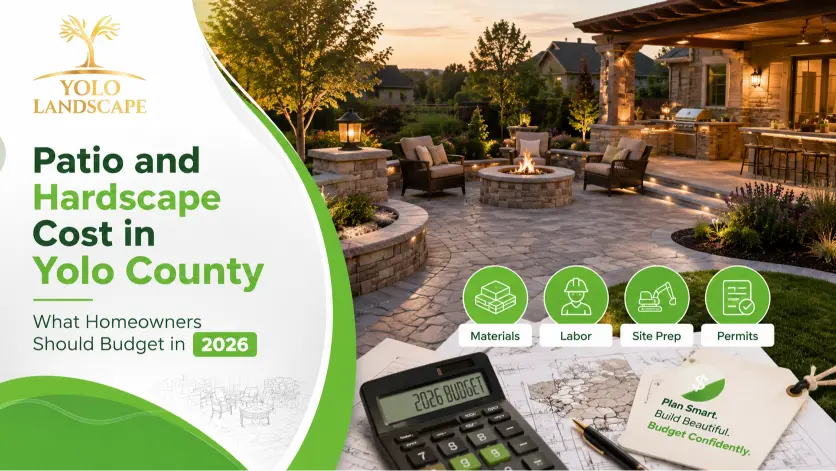
Patio and hardscape costs in Yolo County in 2026 range from roughly $3,000 for a small basic patio to $60,000 or more for a premium outdoor living space with an outdoor kitchen, fire pit, retaining walls, and outdoor lighting. The most common mid-range project, a 300 to 500 square foot paver patio with proper base preparation and drainage, typically runs $12,000 to $25,000 installed in this region. Concrete patio costs and stamped concrete patio costs generally come in lower than paver patio costs upfront but carry higher long-term maintenance expenses.
| Project Type | Average Cost Range |
|---|---|
| Small Patio (under 200 sq ft) | $3,000 to $8,000 |
| Mid-Size Patio (200 to 500 sq ft) | $8,000 to $22,000 |
| Premium Hardscape | $22,000 to $60,000 |
| Luxury Outdoor Living | $60,000 and above |
How Much Does a Patio and Hardscape Cost in Yolo County in 2026?
The most honest answer is that patio installation costs in Yolo County are higher than the national averages you see on Angi or HomeGuide. California labor rates, regional material costs, and the specific site conditions common across the Central Valley all push pricing above what you would pay in the Midwest or South.
Average Cost Per Square Foot Breakdown
Here is what homeowners across Yolo County are actually paying in 2026 based on current contractor pricing in the region:
| Material | Cost Per Square Foot Installed |
|---|---|
| Basic concrete slab | $9 to $15 per sq ft |
| Stamped concrete | $15 to $28 per sq ft |
| Standard pavers (concrete) | $18 to $30 per sq ft |
| Premium pavers (porcelain, travertine) | $30 to $50 per sq ft |
| Flagstone | $25 to $45 per sq ft |
| Travertine | $28 to $50 per sq ft |
These numbers include base preparation, compaction, drainage, labor, and materials. They do not include demolition of an existing surface, excavation for significant grade changes, or permit fees.
Why Local Pricing Is Higher Than National Averages
California contractor labor rates are genuinely among the highest in the country. Skilled masonry labor in the Sacramento metro area and Yolo County runs $65 to $100 per hour compared to $40 to $60 per hour in many other states. Material delivery costs also increase in less urban areas. And California’s environmental regulations affect how certain materials are handled and disposed of, adding compliance costs that national pricing guides completely ignore.
What Factors Affect Patio and Hardscape Costs the Most?
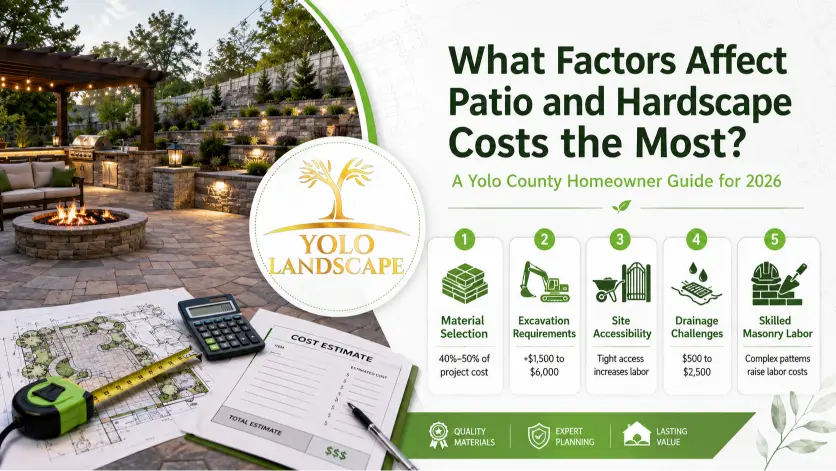
This is where most homeowners get surprised. The material you choose is actually not the biggest cost driver on most projects. Site conditions, labor complexity, and access issues often matter more.
Material Selection
Materials account for roughly 40% to 50% of most patio installation costs. Choosing stamped concrete over basic concrete adds $6 to $13 per square foot. Upgrading from standard concrete pavers to travertine or porcelain pavers adds $12 to $20 per square foot. Those differences matter, but they are often smaller than what site conditions add.
Excavation Requirements
If your backyard is not level, meaningful excavation and grading work is required before any surface goes in. Excavation costs in Yolo County typically run $50 to $150 per hour for equipment and operator. A project requiring significant grade correction can add $1,500 to $6,000 to the total budget before a single paver is laid.
Site Accessibility
This one surprises homeowners more than almost anything else. If your backyard has narrow side yard access, skid steer equipment cannot get in easily. Materials have to be carried by hand or wheelbarrowed through tight gates. That dramatically increases labor hours. A patio that takes 3 days with equipment access can take 5 days without it, and you pay for every hour of the difference.
Drainage Challenges
Drainage is one of the most underdiscussed cost factors in hardscape pricing. A properly installed patio needs to slope away from the house and direct water toward an appropriate outlet. If your yard has existing drainage problems, those must be corrected as part of the project. Adding a drainage system including channel drains and a proper outlet runs $500 to $2,500 depending on complexity.
Skilled Masonry Labor
Skilled masonry labor for pattern work, flagstone cutting, and intricate paver layouts runs higher than basic installation. Complex patterns like herringbone add roughly 15% to 25% to labor costs compared to a standard running bond. Custom inlays and decorative concrete borders add time and cost on top of that.
How Much Does a Concrete Patio Cost in Yolo County?
Concrete is the most budget-friendly starting point for a finished outdoor living space, and it remains one of the most popular choices across Woodland and surrounding communities.
Basic Concrete Pricing
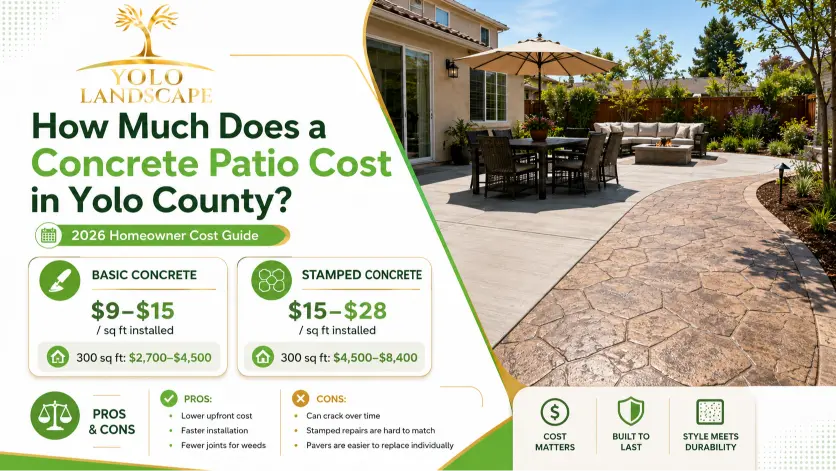
A standard broom-finished concrete patio runs $9 to $15 per square foot installed in Yolo County in 2026. For a typical 300 square foot patio, that translates to $2,700 to $4,500 total. It is functional, durable in California’s heat, and requires relatively straightforward installation.
Stamped Concrete Patio Cost
Stamped concrete adds decorative texture and pattern to a standard slab, mimicking the look of pavers, stone, or brick at a lower material cost. Stamped concrete patio costs in Yolo County run $15 to $28 per square foot installed. A 300 square foot project comes out to roughly $4,500 to $8,400.
Pros and Cons of Concrete
Concrete costs less upfront than pavers or natural stone. It installs faster and has fewer joints where weeds can establish. The tradeoff is that concrete cracks over time, especially in California’s heat and freeze cycles. Repairs to cracked stamped concrete are expensive because matching existing color and pattern is nearly impossible. Pavers, by contrast, can be individually replaced if one shifts or breaks
How Much Does a Paver Patio Cost Per Square Foot?
Paver patio costs in California sit higher than national averages because of regional labor rates and the premium that Yolo County homeowners increasingly place on durability and resale appeal.
Standard Pavers
Standard concrete pavers installed in Yolo County run $18 to $28 per square foot all-in. A 300 square foot project using standard concrete pavers lands between $5,400 and $8,400. A 500 square foot project runs $9,000 to $14,000.
Premium Pavers
Porcelain pavers and travertine push costs to $30 to $50 per square foot installed. These materials are genuinely stunning in outdoor settings and they perform exceptionally well in the California heat, resisting thermal expansion better than most alternatives. A 400 square foot travertine patio can run $12,000 to $20,000 installed.
Permeable Pavers
Permeable pavers allow water to pass through the surface rather than running off. They cost more to install, $25 to $40 per square foot typically, but they address drainage challenges at the surface level and can reduce or eliminate the need for separate drainage systems. In areas of Yolo County with clay-heavy soil that does not drain well, permeable pavers are worth a serious look.
Is Stamped Concrete Cheaper Than Pavers?
This is one of the most searched questions we see, and the answer is yes upfront but not always over time.
Upfront Costs
Stamped concrete patio costs run roughly 30% to 40% less than comparable paver patio costs at the time of installation. A 300 square foot stamped concrete patio might cost $5,000 to $7,000 where the same space in pavers runs $7,000 to $9,500. That difference is real and meaningful for budget-conscious homeowners.
Maintenance Costs
Concrete requires resealing every two to three years to maintain its appearance and protect the surface. In Yolo County’s intense summer heat, unsealed stamped concrete fades and becomes porous faster than in milder climates. Resealing costs $1 to $3 per square foot each time. Over ten years that adds $600 to $2,700 in maintenance costs on a 300 square foot patio.
Lifespan Comparison
Concrete patios in California typically last 20 to 30 years before significant cracking or surface deterioration requires action. Paver patios, properly installed with a compacted gravel base and polymeric sand joints, can last 40 to 50 years and be repaired indefinitely by replacing individual pavers as needed.
Best Choice for California Homes
For homeowners planning to stay long-term and wanting minimal ongoing maintenance, pavers generally deliver better long-term value. For homeowners working within a tight budget or planning to sell within five to seven years, stamped concrete can be a smart choice, especially if the design is simple and the installation quality is high.
What Hidden Costs Should Homeowners Expect?
This section covers what most hardscape pricing guides online completely skip, and it is genuinely where budgets fall apart.
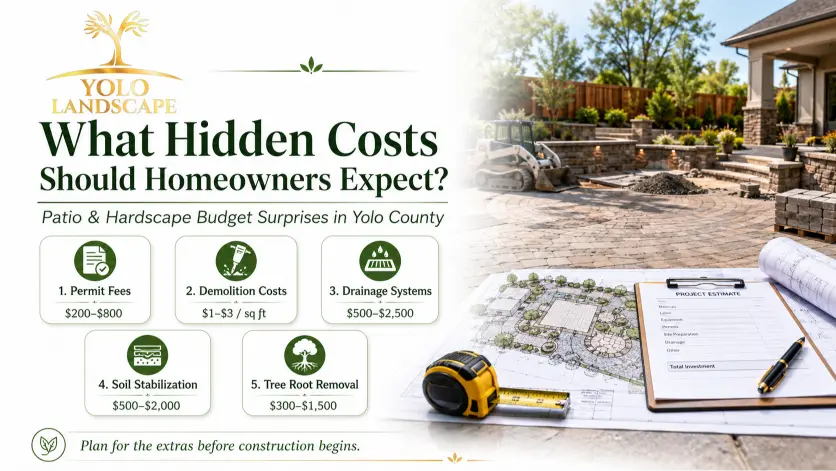
Permit Fees
Most hardscape projects in Yolo County above a certain size or within a certain distance of structures require building permits. Permit costs typically run $200 to $800 depending on project scope and the specific city. West Sacramento, Woodland, and Davis each have their own requirements. Skipping permits creates problems when you sell the property.
Demolition Costs
If an existing patio, concrete slab, or surface needs removal before new work begins, add $1 to $3 per square foot for demolition and haul-away. A 400 square foot existing concrete slab costs $400 to $1,200 to remove before new work can start.
Drainage Systems
As mentioned earlier, proper drainage is not optional. Budget $500 to $2,500 for channel drains and appropriate outlets on most standard projects. On properties with serious existing drainage problems, that number can climb higher.
Soil Stabilization
Yolo County’s Central Valley clay soil expands and contracts significantly with moisture changes. Some projects require geotextile fabric, additional base depth, or soil amendment to create a stable foundation. This adds $500 to $2,000 depending on soil conditions at your specific site.
Tree Root Removal
This one catches homeowners completely off guard. Backyard projects near mature trees often encounter significant root systems that must be carefully removed or rerouted. Root removal adds $300 to $1,500 depending on severity, and occasionally requires an arborist consultation on top of that.
How Much Does a Full Backyard Hardscape Project Cost Beyond the Patio?
Most completed outdoor spaces include more than just the patio surface. Here is what adding common features costs in Yolo County in 2026.
| Feature | Typical Cost Range |
|---|---|
| Walkways | $1,500 to $5,000 |
| Retaining wall (per linear foot) | $50 to $150 |
| Fire pit (built-in) | $3,000 to $8,000 |
| Outdoor kitchen | $8,000 to $35,000 |
| Seating walls | $150 to $300 per linear foot |
| Outdoor lighting | $1,500 to $6,000 |
| Pergola | $5,000 to $18,000 |
These are installed costs including materials and labor in the Yolo County and greater Sacramento metro region. Our “hardscape design and installation” team at Yolo Landscape can help scope any combination of these features into a project budget that makes sense before any commitment is made.
What Does a Small, Mid-Size, and Luxury Patio Project Cost?
Small Backyard Example (Under 200 sq ft)
A homeowner in Winters wanted a simple outdoor seating area behind her home. 180 square feet of standard concrete pavers, proper base work, basic drainage slope, and cleanup. Total project cost: $5,800. No demolition needed. Standard backyard access. This is a realistic entry point for a quality small patio in Yolo County.
Family Entertainment Space (300 to 500 sq ft)
A Davis family wanted a proper outdoor entertaining area with room for dining and lounging. 420 square feet of travertine pavers, a built-in fire pit, two sections of seating wall, and channel drainage along the house. Total project cost: $31,500. This mid-range project is the most common scope we see, and it is where most families end up once they start adding features.
Premium Outdoor Living Project
A Woodland homeowner wanted a complete outdoor living space: 600 square feet of premium porcelain pavers, a full outdoor kitchen with countertops and appliances, an integrated fire feature, retaining wall along the back fence line, outdoor lighting throughout, and a pergola. Total project cost: $78,000. Projects at this level are genuine long-term investments that fundamentally change how a property is used and perceived.
Why Do Patio Quotes Vary So Much?
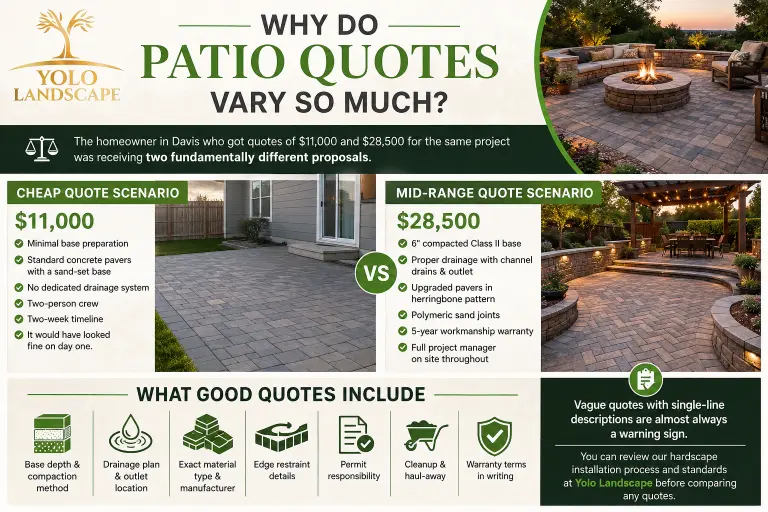
The homeowner in Davis who got quotes of $11,000 and $28,500 for the same project was not being scammed by either contractor. She was receiving two fundamentally different proposals.
Cheap Quote Scenario
The $11,000 quote included minimal base preparation, standard concrete pavers with a sand-set base rather than a compacted gravel base, no dedicated drainage system, and a two-person crew with a two-week timeline. It would have looked fine on day one.
Mid-Range Quote Scenario
The $28,500 quote included 6 inches of compacted class II base, proper drainage with channel drains connected to an appropriate outlet, upgraded concrete pavers in a herringbone pattern, polymeric sand joints, a 5-year workmanship warranty, and a full project manager on site throughout.
What Good Quotes Include
A properly detailed hardscape contractor quote should specify base depth and compaction method, drainage plan and outlet location, exact material type and manufacturer, edge restraint details, permit responsibility, cleanup and haul-away, and warranty terms in writing. Vague quotes with single-line descriptions are almost always a warning sign.
You can review “our hardscape installation process and standards” at Yolo Landscape before comparing any quotes, which gives you a baseline for what thorough work actually looks like.
Can a Patio Increase Property Value in Yolo County?
The short answer is yes, meaningfully. The longer answer is that quality of installation matters as much as the project itself.
ROI Potential
The National Association of Realtors consistently cites outdoor living space improvements among the highest ROI home renovations. Well-executed paver patios recover 70% to 80% of their installation cost in appraised value and significantly reduce time on market in competitive listings. In the California market where outdoor space is a major buyer priority, that number is often higher.
Buyer Demand Trends
Yolo County buyers in the Davis and Woodland markets consistently rank functional outdoor entertaining space among their top three property priorities. A professionally installed outdoor living space with a patio, fire feature, and clean landscaping creates immediate buyer differentiation in a competitive market.
What Mistakes Increase Patio Costs Later?
Skipping Base Preparation
This is the most expensive mistake in hardscape work. A paver or concrete surface is only as stable as what is underneath it. Inadequate base depth or poor compaction causes settling, cracking, and uneven surfaces within two to four years. Fixing it means pulling up and reinstalling the entire surface, which costs as much as the original project in many cases.
Poor Drainage Planning
Water sitting on or near a patio surface after rain accelerates settling, stains surfaces, and can undermine the base over time. Drainage is not an upgrade. It is a fundamental part of every quality installation.
Ignoring Permits
Unpermitted structures complicate property sales and can result in mandatory removal orders. The cost of obtaining a permit upfront is a fraction of the cost of dealing with permit issues during a sale.
How Can Homeowners Save Money on a Hardscape Project?
Timing Your Project
Hardscape contractors in Yolo County are typically busiest from March through September. Scheduling work in October through February often allows for better pricing and faster scheduling because crews have more availability.
Bundling Features Together
If you want a patio, walkway, and retaining wall, getting them done in one project is always cheaper than doing them separately. Mobilization, equipment, and base preparation costs are shared across a larger scope. Our “landscape construction and hardscape services” covers how we approach bundled project planning in Yolo County.
Getting Competitive Quotes
Get at least three detailed, line-item quotes for any project over $10,000. Compare them by what is included, not just the total number. A quote that is $3,000 lower but excludes drainage, permits, and cleanup is often more expensive in practice.
Conclusion
Patio and hardscape costs in Yolo County in 2026 range widely because projects range widely. A small, simple concrete patio and a luxury outdoor living space with an outdoor kitchen, travertine pavers, and integrated outdoor lighting are both called patios in everyday conversation. But their price tags, their complexity, and their long-term value are completely different conversations.
What stays consistent across every project is this: quality base preparation and proper drainage matter more than any material choice. A beautifully installed $8,000 concrete patio will outlast and outperform a poorly installed $15,000 paver project every single time.If you are in Woodland, Davis, Winters, or West Sacramento and starting to plan a backyard project, the most valuable first step is an honest site assessment, not a rushed quote based on guesswork. Our “patio and hardscape installation team” at Yolo Landscape has been working across Yolo County long enough to know exactly what site conditions to expect in this region and how to price honestly around them.