
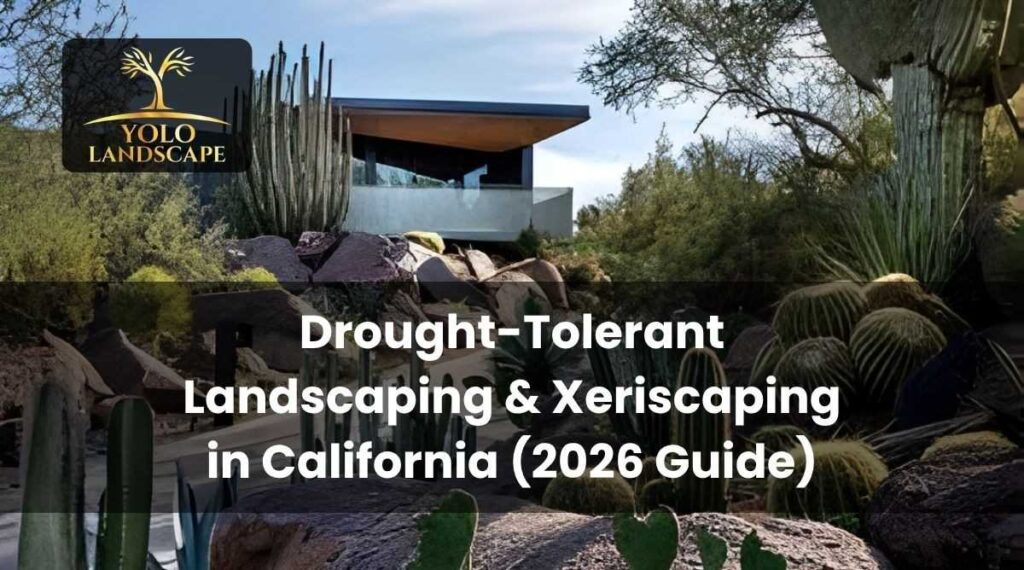
Summer hit Woodland, California, hard last year. A homeowner in Yolo County called us in a panic. Her water bill had jumped to $340 in a single month. Her lawn looked brown anyway. She was frustrated, embarrassed, and ready for a real change.
Does that sound familiar? Here is the truth nobody says out loud: traditional grass lawns are one of the most expensive, water-hungry, environmentally damaging things you can put in a California backyard. And in 2026, with water restrictions tightening across Sacramento and beyond, holding onto one is becoming harder to justify.
This guide will show you exactly how drought-tolerant landscaping works, how much money it actually saves, and how to make your yard look better than it ever did with grass. We cover real costs, real rebate programs, the best California native plants, step-by-step lawn removal, and the honest mistakes people make when switching. No fluff.
By the time you finish reading, you will know whether xeriscaping is right for you and how to get started without wasting money.
What Do These Terms Actually Mean?
A lot of homeowners come to us confused because everyone uses these terms differently. Let’s set the record straight.
What Is Drought-Tolerant Landscaping?
Drought-tolerant landscaping is a style of yard design that uses plants, ground covers, and layouts built to survive with minimal water. The focus is on choosing the right plants for a hot, dry climate and arranging them so your yard thrives even during California’s long dry seasons.
It does not mean your yard has to look dry or neglected.
What Is Xeriscaping and Is It Different?
Xeriscaping is a full landscape planning method developed specifically to reduce outdoor water use. The word comes from the Greek word “xeros,” meaning dry. It is not just a plant list. It is a design philosophy that includes soil preparation, mulching, smart irrigation, and plant grouping based on water needs.
People picture rocks and cactus. What you actually get, when done right, is a layered, textured yard with color, structure, and life.
What Makes a Traditional Lawn a Problem?
A traditional grass lawn in California uses roughly 40 to 60 gallons of water per square foot each year. That adds up fast. On top of that, lawns need regular mowing, fertilizing, aerating, and pest control. They are expensive to maintain and frankly, not suited for our climate at all.
The California drought has pushed policymakers to limit outdoor watering in many counties, and that pressure is only growing.
How Much Water Can You Actually Save with Xeriscaping?
This is where things get exciting. I have seen homeowners cut their water bills by 50% to 75% after switching to water-efficient landscaping. That is not a marketing claim. That is documented in studies from the Metropolitan Water District of Southern California and repeated in real projects we have worked on here in Yolo County.
Here is a simple comparison:
|
Yard Type |
Monthly Water Use (avg. 1,500 sq ft) |
Estimated Monthly Cost |
|
Traditional lawn |
9,000 to 12,000 gallons |
$140 to $200+ |
|
Drought-tolerant landscaping |
2,500 to 4,500 gallons |
$40 to $80 |
|
Full xeriscape (with drip irrigation) |
1,000 to 2,500 gallons |
$20 to $45 |
These numbers are based on average Sacramento area water rates and typical residential lot sizes. Your exact savings depend on your layout, plants, and current setup. But the direction is always the same. Down. Significantly.
One of our clients in Davis reduced her water bill from $280 a month to $94 after we removed her lawn and installed a layered native garden with a drip irrigation system. That is $186 saved every single month. Over a year, that is more than $2,200 back in her pocket.
Will a Xeriscape Yard Look Dry or Unattractive?
This is the fear I hear most often. People imagine a dusty patch of gravel and wonder if their neighbors will complain.
Here is my honest take: the ugliest xeriscaping I have ever seen was still done by someone who tried to do it on the cheap with zero design input. The most beautiful yards I have ever seen in California have been water-smart designs. Not lawns.
Modern low-water garden design can include flowering lavender borders, ornamental grasses, California lilac (Ceanothus) that blooms brilliantly blue in spring, clusters of succulents in terracotta tones, and gravel landscaping paths that frame everything beautifully.
Add a pergola or shade structure, and you have an outdoor living room that costs almost nothing to maintain.
The key is layering. Tall background plants, mid-layer shrubs, low ground covers, and accent stones or mulch in between. When you layer correctly, the yard looks intentional and full, not bare.
What Are the Best Drought-Tolerant Plants for California Heat?
Choosing the right plants is where drought-tolerant landscaping in California either succeeds or falls apart. The good news is that California is blessed with an incredible range of beautiful, heat-resistant plants.
Here are some of our favorite recommendations based on what actually performs well in Sacramento and Yolo County climates:
Flowering Shrubs and Groundcovers
- California Lilac (Ceanothus): Stunning blue flowers, zero summer water once established
- Manzanita: Sculptural form, red bark, beloved by hummingbirds
- Lavender: Fragrant, drought-hardy, and deer-resistant
Succulents and Accent Plants
- Agave: Bold structure, almost no water needed
- Cacti: Perfect for hot, south-facing spots
- Aloe vera: Great for edges and containers
Low-Growing Ground Covers
- Dymondia (Silver Carpet): Holds moisture in soil, tolerates foot traffic
- Creeping thyme: Smells amazing, stays low, looks lush
Grasses and Fillers
- Blue fescue: Soft, bluish tones, needs very little water
- Deer grass (Muhlenbergia): Waves beautifully in the wind
For Sacramento landscaping ideas that survive the heat, combine at least three layers from this list. You get color in every season without fighting the climate.
How Do You Replace Your Lawn Step by Step?
Lawn replacement in California is not complicated if you follow the right order. Here is the process we use at Yolo Landscape:
Step 1: Measure and Plan (1 to 2 days)
Map your yard, identify sun exposure zones, and mark areas where you want paths, plants, or sitting areas.
Step 2: Kill the Grass (2 to 6 weeks)
You can use the sheet mulching method (cardboard and wood chips) or solarization (clear plastic during summer). Avoid herbicides if possible, especially near food gardens.
Step 3: Prepare the Soil (1 to 2 days)
Add compost and loosen the top 6 inches of soil. Good soil health is what separates a thriving xeriscape from a struggling one.
Step 4: Install Irrigation (1 day)
A drip irrigation system delivers water directly to plant roots, reducing waste by 30% to 50% compared to sprinklers. Pair it with a soil moisture sensor or smart sprinkler controller for even better results.
Step 5: Lay Mulch (half a day)
Apply 3 to 4 inches of mulch. This alone can cut water evaporation from your soil by up to 70%. Mulch landscaping benefits go beyond water savings. It suppresses weeds and improves soil temperature.
Step 6: Plant and Finish (1 to 2 days)
Plant in fall or early spring when temperatures are mild. Water deeply twice a week for the first few months, then taper off as plants establish.
Total timeline from grass removal to finished yard: 4 to 8 weeks, depending on size.
Can You Get Rebates for Removing Your Lawn in California?
Yes, and this is one of the most underused opportunities I see homeowners miss completely.
Several grass removal rebate programs exist right now in California:
- Metropolitan Water District (MWD): Offers up to $3 per square foot of turf removed in qualifying districts
- Sacramento Suburban Water District: Active rebate programs for converting to water-smart landscaping
- East Bay MUD: Pays rebates for both turf removal and drip irrigation system installation
- Yolo County Water Agency: Contact them directly for current program availability
Some programs also offer rebates on smart irrigation systems and soil moisture sensors. The application process usually involves before-and-after photos, a simple form, and proof of water service.
In 2026, lawn removal rebate programs across California have expanded significantly due to continued drought conditions. If you live in Davis, Woodland, or surrounding Yolo County communities, it is worth making a few calls before you start your project. You could get hundreds or even thousands of dollars back.
Does Drought-Tolerant Landscaping Actually Save Money Long Term?
Let’s talk real numbers.
A drought-tolerant landscaping project for an average front yard (roughly 500 to 800 square feet) in California costs between $3,500 and $8,000 installed professionally. That includes soil prep, plants, mulch, drip irrigation, and finishing touches.
Sounds like a lot. But consider:
- Water savings of $100 to $200 per month
- Break-even point: 24 to 36 months
- After that, pure savings for the life of your home
Add in rebate money, and the break-even point drops even faster. And because eco-friendly landscaping ideas have become a strong selling point in California real estate, your investment may actually increase your home value at the same time.
According to research from the University of Nevada Cooperative Extension, homes with water-efficient landscaping sell faster and often at higher prices in drought-prone Western states.
What Are the Best Alternatives to Grass?
If you are not ready for a full xeriscape redesign, switching just the ground cover makes a massive difference. Here is a quick comparison:
|
Alternative |
Water Use |
Maintenance |
Cost (per sq ft) |
Look |
|
Mulch |
Very low |
Low |
$0.50 to $1.50 |
Natural |
|
Gravel landscaping |
None |
Very low |
$1.00 to $3.00 |
Clean, modern |
|
Artificial turf |
None |
Low |
$8.00 to $14.00 |
Green year-round |
|
Native ground covers |
Very low |
Low |
$2.00 to $5.00 |
Lush, natural |
|
Decomposed granite |
None |
Very low |
$1.00 to $2.50 |
Earthy, warm |
Each option has trade-offs. Gravel landscaping looks sharp but can get hot in direct sun. Artificial turf eliminates water use but has an upfront cost and environmental footprint. Native ground covers take time to establish but look incredible once they do.
My personal preference for most Yolo County homeowners is a combination: gravel or mulch in the paths and open areas, native ground covers where you want softness, and rock garden ideas as accent features.
What Irrigation Systems Work Best for Water-Saving Gardens?
Drip irrigation is the gold standard for drought-tolerant landscaping. It delivers water directly to the root zone, eliminating surface evaporation and runoff.
The best systems we recommend and use:
- Rain Bird drip irrigation kits: Reliable, widely available, easy to DIY
- Hunter Pro-C with soil moisture sensor: Great for larger yards
- Rachio 3 smart controller: Connects to weather data and adjusts your watering schedule automatically
Pair any of these with a rainwater harvesting barrel for supplemental water, and you have a nearly self-sustaining yard. Greywater systems are also legal in California for outdoor irrigation use and can further reduce your municipal water draw.
What Mistakes Should You Avoid When Switching?
I have seen these mistakes cost homeowners thousands of dollars. Learn from them before you start.
Planting too much too fast. Give plants space to grow. Overplanting creates competition for water and light and actually leads to more watering in year one.
Skipping soil preparation. Most California soils are heavy clay or sandy loam. Neither drains perfectly without amendment. Skip the compost step, and you will fight poor drainage for years.
Choosing the wrong plants for your climate zone. California has many USDA zones. A plant that thrives in Sacramento may struggle in a coastal microclimate. Always check your specific zone before buying.
Installing sprinklers instead of drip. This is the single biggest water-wasting mistake in water-efficient landscaping. Sprinklers lose 30% to 50% of their output to evaporation before it ever hits the soil.
Not applying enough mulch. Homeowners often apply one inch. You need at least three to four. Anything less and you lose most of the water retention benefit.
What Mistakes Should You Avoid When Switching?
In short, yes. And the margin is growing.
California buyers in 2026 increasingly look for homes with low-maintenance, low-water yards. Especially in Sacramento and surrounding communities, where water rates keep climbing. A well-designed xeriscape yard signals smart ownership. It shows the home is adapted for the future, not fighting it.
Real estate professionals we have spoken to in the Davis and Woodland markets confirm that attractive drought-resistant landscaping has become a real selling point, not just a nice-to-have. One agent described a lawn replacement project as the single renovation that generated the most buyer comments during open houses.
If you are thinking about selling in the next three to five years, this is one of the smartest yard investments you can make.
How to Maintain a Drought-Tolerant Garden Without Much Effort
This is the part people underestimate in a good way. Drought-tolerant landscaping is genuinely low maintenance once established.
Year One: Water twice a week for the first two to three months. Weed any bare soil spots. Top up mulch where it thins out.
Year Two and Beyond: Most California native plants need zero supplemental water from late fall through spring. In summer, one deep watering per week is usually enough. A quarterly check of your drip emitters and an annual mulch refresh is typically all the maintenance a healthy xeriscape needs.
Compare that to mowing twice a week, fertilizing monthly, dethatching annually, and fighting fungal disease every wet season. The difference in time and money is dramatic.
How Yolo Landscape Can Help You Make the Transition
At Yolo Landscape, we have been designing and installing drought-tolerant landscaping across Yolo County, Sacramento, Davis, Woodland, and Winters since 2016. We do the full project from start to finish, including soil prep, plant selection, drip irrigation system installation, decorative rock and gravel work, hardscaping, and mulch application.
We also handle lawn replacement projects from start to finish, which means we can help you document everything you need for rebate applications, too.
If you are ready to stop fighting your lawn and start saving water, we would love to help. You can get a free quote at yololandscape or call us directly. We serve all communities within 25 miles of Woodland, CA.
Final Thoughts: Your Lawn Is Costing You More Than You Think
Three months after that Woodland homeowner called us in a panic; her yard looked nothing like it used to. And it cost her far less to maintain. She had a layered native garden, a winding gravel path, a small seating area under a pergola, and a water bill that had dropped by more than 60%.
Drought-tolerant landscaping in California is not a compromise. It is an upgrade. It is smarter, cheaper, more beautiful, and honestly just more honest about the climate we actually live in.
The question is not whether xeriscaping makes sense for California homeowners in 2026. It clearly does. The question is how long you want to keep paying for a lawn that is working against you.
Ready to make the change? Yolo Landscape serves Yolo County, Davis, Sacramento, Woodland, Winters, and the surrounding communities. Get your free quote at yololandscape and let’s build something worth keeping.
What part of your yard do you want to transform first?
Frequently Asked Questions
What is xeriscaping?
It is a smart way to design your yard using drought-tolerant plants, mulch, and drip irrigation so you use far less water. It is not just rocks and cactus. A well-planned xeriscape looks full, layered, and genuinely beautiful.
How much does drought-tolerant landscaping cost in California?
Professional installs in California typically run $3,500 to $8,000 for a front yard. DIY can start under $1,500. Grass removal rebates through local programs can bring that number down meaningfully.
Does xeriscaping really save water?
It does. Most homeowners cut outdoor water use by 50% to 75% after switching to water-efficient landscaping. In California markets, that usually means $100 to $200 back in your pocket every single month.
Can a xeriscape yard still look green?
Yes. California native plants like Ceanothus, ornamental grasses, and low ground covers stay full and green with very little water. Honest answer: design matters more than any individual plant you pick.
What are the best plants for California heat?
Lavender, Manzanita, California Lilac, agave, blue fescue, and succulents all perform well. They are true heat-resistant plants built for our climate, and they hold up through long dry seasons without much help.
How long does lawn removal take?
Physical removal takes one to two days. If you use solarization or sheet mulching to kill the grass naturally, add two to six weeks. Full lawn replacement in California from start to finish usually wraps up in four to eight weeks.
Are rebates available for removing a lawn in California?
Yes, and most homeowners never use them. MWD and Sacramento Suburban Water District both offer up to $3 per square foot. Yolo County residents should contact the Yolo County Water Agency to check current availability.
Is drought-tolerant landscaping low maintenance?
After year one, genuinely yes. Established California native plants need almost no summer watering. An annual mulch top-up and a quick drip-emitter check are usually all it takes to keep things looking sharp.
Does xeriscaping increase home value?
It does, especially now. California buyers actively look for low-water yards in 2026. A well-designed drought-tolerant landscaping project can speed up your sale and strengthen your asking price in Sacramento and Yolo County markets.
What is the cheapest way to start?
Replace just your front lawn first. Apply 3 to 4 inches of mulch to existing beds and switch to a drip irrigation system. Those three steps alone will cut your water bill noticeably before you spend anything major.
Can a beginner do this?
You can, but mistakes in plant selection and soil prep get expensive fast. Yolo Landscape offers free consultations and works with your budget, whether you want a full install or just a solid plan to follow yourself.
What are the most common mistakes?
Skipping soil prep, using sprinklers instead of drip irrigation, planting too close together, and applying too little mulch. Every one of these is avoidable. Plan the soil and the water first, and you will save yourself a lot of frustration.
How often do you water a xeriscape?
In California summers, one deep watering per week is usually enough after the first year. A smart sprinkler controller paired with a soil moisture sensor handles the timing automatically, so you never have to guess.
Is artificial turf better than xeriscaping?
It uses no water, but the upfront cost is high, and the environmental trade-offs are real. Drought-tolerant landscaping with California native plants is generally the stronger long-term choice for both your wallet and your soil health.
What is the best design for a small backyard?
Layering works best. Tall plants at the back, mid-level shrubs in the middle, low ground covers at the front, with gravel or decomposed granite paths connecting it all. Add a small seating area, and the space feels complete and intentional.