
You water on Tuesday. By Friday, your lawn looks burnt. You water again, nothing changes. In Davis and Woodland, this happens fast once temperatures cross 100°F.
Here’s the part most people miss: during Yolo County lawn care summer heat, lawns don’t fail because of heat alone. They fail because of how they’re watered, cut, and handled when the soil is already under stress. High evapotranspiration, hot root zones, and clay-heavy soil make things worse if the approach is off. That’s why more water doesn’t fix it. It often makes it worse.
If your lawn is fading despite effort, you’re likely making 2–3 common mistakes. Fix those first, and you can turn it around before real damage sets in.
What Most Homeowners Get Wrong (And How to Fix It)
If your lawn is struggling in this heat, it’s usually not one big issue, it’s a few habits that quietly make things worse.
- Watering a little every day
Feels right, but it isn’t. It keeps roots near the surface, where heat dries them out fast. Deep watering builds stronger roots that can actually handle drought stress. - Cutting the grass too short
Short lawns heat up quicker. You lose shade at soil level, and moisture disappears faster. Keeping it slightly longer protects against soil temperature spikes. - Fertilising at the wrong time
In extreme heat, growth slows naturally. Adding nitrogen pushes the grass when it’s already stressed. That’s when damage shows up. - Treating all grass the same
Tall Fescue and Bermudagrass don’t behave the same in Sacramento Valley conditions. What works for one can weaken the other. - Blaming water when the soil is the problem
If the ground is compacted, water doesn’t move properly. Poor water infiltration means roots never get what they need, no matter how often you water.
Fix these first. Most lawns start recovering once these are sorted.
Why Do Lawns Die So Fast in Yolo County Summer Heat?
It’s not just the heat. It’s how it hits here. In places like Davis and Woodland, the air stays dry, and there’s almost always a bit of wind moving through. You water, it looks fine for a day or two, then it just drops off again. Happens a lot in the Central Valley.
Part of it is how fast moisture disappears. In peak summer, the lawn is losing water pretty much all day, through the soil and the grass itself. And if the soil’s on the heavier side, it doesn’t always soak in properly either. So even when you water, not much of it actually reaches where it’s needed.
That’s why lawns go brown so quickly. It’s not one thing, it’s a mix of heat, dry air, and how the ground handles water.
Heat Stress vs Drought Stress: What Most People Mix Up
They look the same at first glance, dry, dull, struggling grass. But what’s actually going on underneath isn’t always the same.
- Drought stress (not enough water)
The grass isn’t getting enough moisture to keep going. You’ll usually see grass wilting signs, slight colour change, and slower growth. - Heat stress (too much temperature)
Even with water, the lawn struggles. Once soil temperature pushes past ~85°F, the grass starts shutting down. - Why it matters
In places like the Sacramento Valley, both often happen together. Adding more water feels like the fix, but on heavy soil, it can sit on the surface.
The key is knowing what you’re dealing with, because the fix isn’t always more water.
What Is the Best Watering Schedule in Extreme Heat?
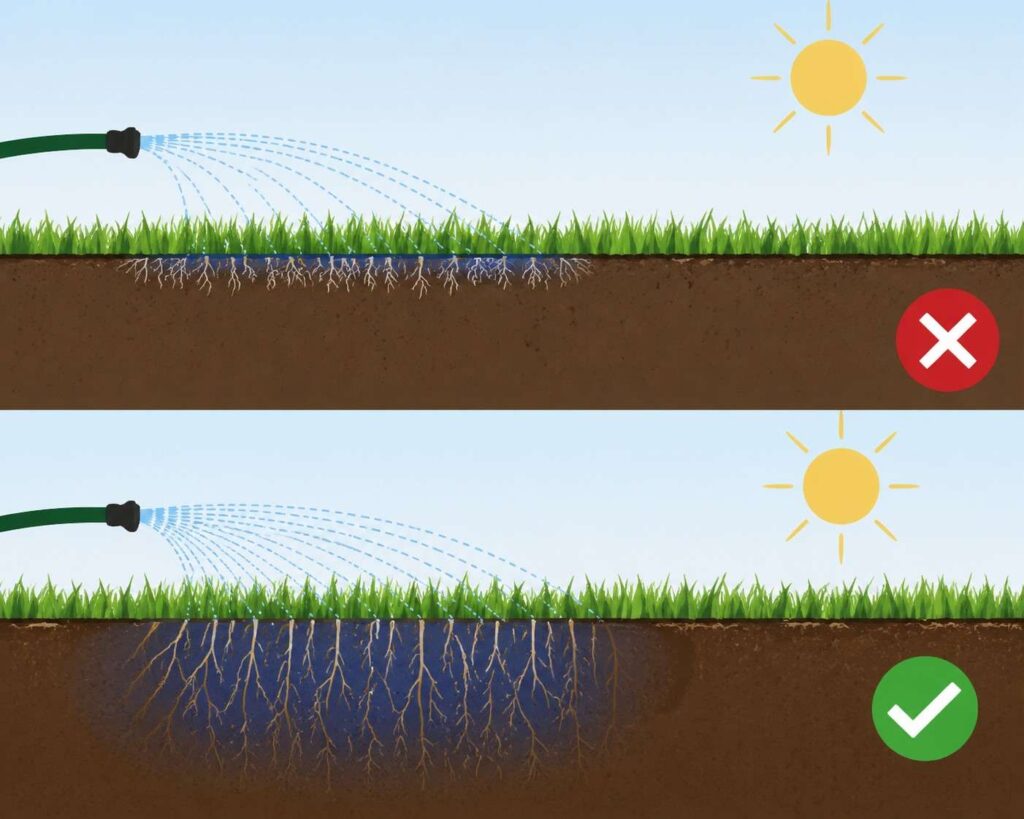
A lot of people still think daily watering keeps a lawn healthy. In this heat, it usually does the opposite. The surface stays damp, but the root zone stays dry, and that’s where the problem starts.
- Why daily watering backfires
Moisture sits in the top inch. Roots follow it. You end up with shallow roots that struggle the moment temperatures spike. - Deep vs daily watering
With deep watering, you’re pushing moisture down 6–8 inches. Then you leave it. The top layer dries slightly, but the roots stay supported underneath. - How often to water grass in 100°F weather
For most yards, that means watering around 2–3 times a week, not every day. The goal isn’t frequency, it’s depth.
Most lawns here don’t fail because of water. It’s how it’s used. In this heat, watering two to three times a week is usually enough if it actually reaches the root zone. Light daily watering just keeps the surface damp, and that dries out fast.
- If you’re unsure whether it’s working, don’t guess. Run your system, then check a few inches below the surface. If it’s still dry there, you’re not watering deep enough, even if the top looks fine.
Exact Watering Timing: What Actually Works in Yolo County Heat
Timing makes a bigger difference than most people think. In Yolo County lawn care in summer heat, watering at the wrong time wastes water before it even reaches the roots.
- Best time to water lawn in summer heat
Early morning, around 4 to 6 AM, is where it works best. The air is cooler, wind is lower across the Central Valley, and more water reaches the soil instead of disappearing. - Why this timing works
Less evaporation, better coverage from your sprinkler system, and the lawn dries after sunrise. That last part helps avoid common fungal issues that show up with evening watering. - If your system can’t do this
A simple upgrade to a smart irrigation controller (ET-based scheduling) can adjust watering automatically based on evapotranspiration (ET) levels. That usually cuts down unnecessary water use without harming the lawn.
Run Time by Soil Type (Simple Guide)
| Soil Type | Run Time | Sessions / Week | Notes |
|---|---|---|---|
| Heavy clay (Yolo adobe) | 8–10 min, then pause | 2–3x | Use cycle-soak to improve water infiltration |
| Yolo silt loam | 15–18 min | 2–3x | Common in Davis CA / Woodland CA |
| Sandy amended soil | 20–25 min | 3x | Drains faster, needs slightly more frequency |
In this heat, more water isn’t the answer, it’s about watering at the right time so it actually counts.
Are You Overwatering or Underwatering? A Quick Way to Tell
When a lawn starts fading, most people assume it needs more water. That’s not always the case, especially in Yolo County lawn care in summer heat, where soil and temperature both affect how water behaves. The problem is, overwatering and underwatering can look almost the same at first.
What the Signs Actually Tell You
If the lawn has a dull blue-grey tone and footprints stay visible after you walk across it, that usually points to grass wilting signs from low moisture, so water isn’t reaching proper root depth. In areas with Yolo silt loam, slow water infiltration means moisture can sit near the surface. It looks dry on top, but it isn’t. That’s where people get caught out. It’s not always about how much water you’re using. It’s how the soil is dealing with it.
Which Grass Type Actually Survives Yolo County Summer Heat?
In this climate, effort alone doesn’t fix it, what you plant matters more. If you’re choosing the best grass for hot dry summers, Bermudagrass and Zoysia usually hold up better here
Warm-season options that hold up
Bermudagrass is the most reliable choice across the Central Valley. It handles heat well, recovers quickly, and doesn’t demand as much water once established. It will turn brown in winter, that’s the trade-off.
Zoysia is a step up in quality. Finer texture, slightly better drought tolerance, and it stays green a bit longer. The downside is slower establishment, so it needs patience early on.
Cool-season grass: what to expect
Tall Fescue can work, but it needs managing. In peak summer, it uses more water than warm-season options. Some homeowners let it ease off during the hottest weeks, then bring it back once temperatures drop. That approach tends to work better than forcing it through extreme heat.
Kentucky Bluegrass doesn’t suit this area well. It struggles in prolonged heat and usually needs more water than most people expect.
Quick Comparison
| Grass Type | Heat Tolerance | Water Need | Fit for Yolo County |
|---|---|---|---|
| Bermudagrass | High | Low | Strong choice |
| Zoysia | High | Very low | Premium option |
| Tall Fescue | Moderate | Moderate–high | Needs strategy |
| Buffalo Grass | Good | Low | Low-traffic areas |
| Kentucky Bluegrass | Low | High | Not suitable |
If you’re choosing based on appearance alone, it often backfires. Matching the grass to the climate usually saves more effort than trying to force the wrong one through summer.
What Is the Correct Mowing Strategy in Summer Heat?
Cutting grass short in summer causes more damage than people realise. It’s one of the most common lawn care mistakes in extreme heat, especially across Yolo County yards in June and July.
Why short grass struggle in heat
Grass blades aren’t just for looks, they protect the soil. When the lawn is cut too low, the surface gets exposed. In this heat, soil temperatures climb fast, moisture disappears, and roots don’t get a chance to recover. Leaving the grass a bit taller creates shade at ground level, which helps keep conditions more stable.
Ideal mowing height by grass type
Different grasses handle height differently, so it’s worth adjusting instead of using one setting year-round:
| Grass Type | Recommended Summer Height |
|---|---|
| Bermudagrass | 1.5 – 2.5 inches |
| Tall Fescue | 3.5 – 4 inches |
| Zoysia | 2 – 2.5 inches |
Try not to remove too much in one go. If the lawn has grown out, bring it down gradually over a couple of cuts instead of all at once.
Leave the clippings: it helps more than you think
Grass clippings break down quickly and return nutrients back into the soil. They also help hold a bit of moisture at the surface, which matters in heatwave lawn care conditions. Done properly, this doesn’t cause thatch, it just supports the lawn through summer.
Should You Fertilize Your Lawn During a Yolo County Summer?
Short answer, avoid it. In peak heat, fertiliser often does more harm than good. It pushes growth when the lawn is already under heat stress, which can lead to burn that looks a lot like drought damage.
When fertilising actually works
Timing matters more than the product. For most Yolo County lawn care in summer routines, this works better:
- Spring (March–April) → light feeding as growth starts
- Early June (only if needed) → small organic boost before soil heats up
- Mid-June to September → leave it alone
- Fall (Sept–Nov) → main feeding window for recovery
That fall period does more for lawn heat recovery than anything you apply in summer.
Organic vs synthetic in heat
If you do apply anything close to summer, go light and slow. Organic options break down gradually, which reduces the risk of pushing growth too hard. Fast-release fertilisers tend to act quickly, and that’s where problems show up in hot, dry conditions.
In most cases, skipping summer fertilising is the safer move. Focus on watering and soil instead, results are usually better.
What Tools Actually Make a Difference in Yolo County Summer Lawn Care
Not every upgrade is worth it. In this heat, a couple of tools make a real difference, mostly by fixing how water is applied.
What’s actually worth using
A smart irrigation controller that adjusts to evapotranspiration (ET) levels is one of the few upgrades that actually makes a difference. Fixed schedules don’t hold up well here. Conditions shift across the Sacramento Valley, and watering needs change with them.
A soil moisture sensor helps with the rest. In heavier soil, it’s not always obvious what’s happening below the surface. A quick check at depth shows whether water is reaching the roots or just sitting near the top.
That’s usually where things change. Not by adding more water, but by using it at the right time and in the right amount.
A Real Lawn Recovery in Yolo County: What Actually Happened
A Davis CA lawn went brown in July. Daily midday watering on clay soil. Roots stayed shallow. Heat did the rest. Fix was simple. Watering stopped for a few days, then switched to deep early morning sessions twice a week. Mowing height was raised. No fertiliser. If you’re dealing with dead spots, knowing how to fix dry patchy lawn summer conditions starts with soil and watering, not reseeding. First green came back in under two weeks. Full recovery took just over a month. Nothing fancy. Just better timing and deeper watering.
Is Lawn Dormancy a Problem or a Smart Strategy?
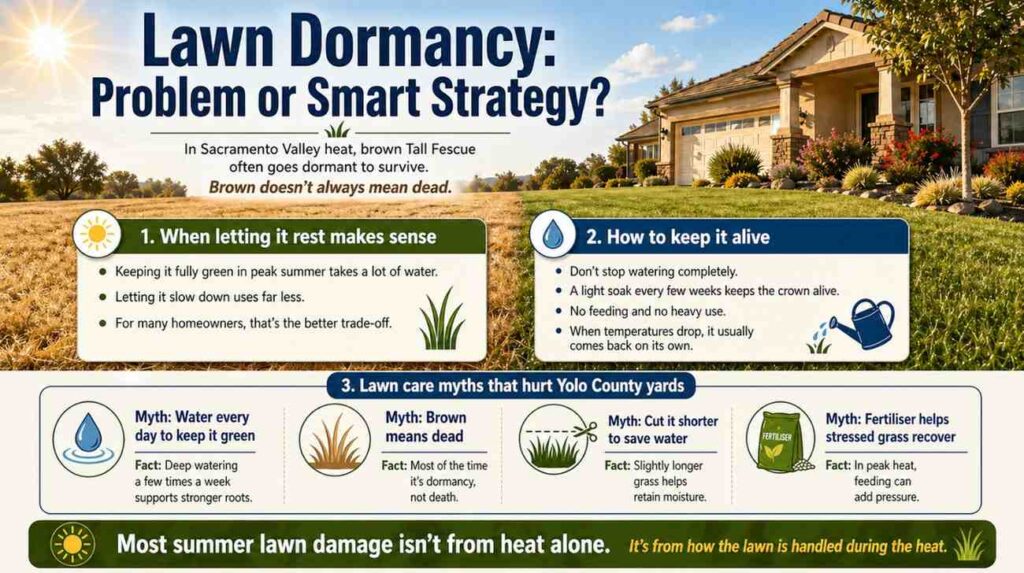
In this heat, brown doesn’t always mean dead. A lot of Tall Fescue lawns in the Sacramento Valley go dormant, it’s normal.
When letting it rest makes more sense
Keeping it fully green in peak summer takes a lot of water. Letting it slow down uses far less. For many homeowners, that’s the better trade-off.
How to keep it alive
Don’t stop watering completely. A light soak every few weeks keeps the crown alive. Leave it alone otherwise, no feeding, no heavy use. When temperatures drop, it usually comes back on its own.
Lawn Care Myths That Quietly Damage Yolo County Yards
A lot of problems come from advice that sounds right but doesn’t hold up in this heat.
- “Water every day to keep it green”
Daily watering keeps roots near the surface. In hot weather, that layer dries out first. Deeper watering a few times a week works better for root depth and heat stress. - “Brown means dead”
Not always. Most of the time it’s lawn dormancy. Check before replacing—many lawns recover once conditions ease. - “Cut it shorter to save water”
Short grass exposes soil. That pushes up soil temperature and speeds up moisture loss. Leaving it slightly longer helps with water retention in soil. - “Fertiliser helps stressed grass recover”
In peak heat, it often does the opposite. Feeding too early adds pressure when the lawn is already struggling.
Most damage isn’t from heat alone, it’s from how it’s handled during it.
Month-by-Month Lawn Strategy for Yolo County
No complicated schedule. Just adjust with the season.
| Period | Focus | Watering | Mowing |
|---|---|---|---|
| Mar–Apr | Prep soil, light feed | 1× weekly (deep) | Normal |
| May | Adjust height, check system | 2× weekly (deep) | Slightly higher |
| Jun | Stop feeding, fix timing | 2–3× weekly | Higher |
| Jul–Aug | Maintain, avoid stress | 2–3× weekly (monitor ET) | Keep high |
| Sep | Recovery + aeration | 2× weekly | Gradual reset |
| Oct | Repair patches, overseed | 1–2× weekly | Normal |
| Nov–Feb | Low activity | Minimal | Low |
If you’re unsure where to start, focus on best time to water lawn in summer heat and mowing height first, those two alone fix most issues.
Strategic Thoughts
Keeping a lawn going through a Yolo County summer isn’t impossible, it just needs a different approach. Most of it comes down to soil and root depth, not how much water you throw at it. Get the basics right: water early, go deeper not daily, keep the grass a bit longer, and don’t fight the climate with the wrong type of turf. That’s usually where things turn around. The rest, tools, feeding, timing, only helps once that foundation is sorted.
If you want to keep lawn green in Yolo County summer, the basics matter more than anything else.